Key Takeaways
AI Agents now plan, execute, and complete tasks autonomously.
AI-only social networks (like 'Moltbook') are emerging.
Multi-agent systems work like human teams for efficiency.
Free tools (ChatGPT, Google AI Studio) are accessible to all.
Artificial Intelligence in 2026 is no longer just about chatbots. The landscape has evolved into autonomous AI agents, multi-agent systems, and AI-only social networks. Discover the historic transformation happening now.
Artificial Intelligence in 2026 is no longer just about chatbots answering questions or tools helping with homework. The AI landscape has rapidly evolved into something much bigger — autonomous AI agents, multi-agent systems, enterprise AI integration, and even AI-only social networks.
For engineering students, developers, and tech enthusiasts, this is not just news — it is a historic transformation happening in real time. This article covers the latest developments in free AI tools, AI agent platforms, and the future of autonomous systems.
🚀 From AI Assistants to AI Agents
Earlier AI systems worked like this: You ask a question → AI gives an answer. Now, AI agents work differently: You give a goal → AI plans → AI executes → AI adapts → AI completes tasks.
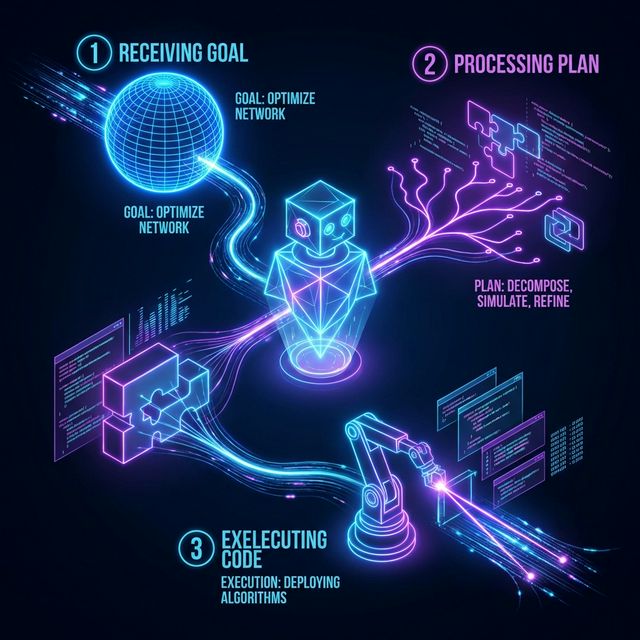
This shift from reactive AI to autonomous AI systems is the biggest transformation of 2026.
🔹 What can an AI Agent do?
- Break complex goals into smaller tasks
- Use APIs and external tools
- Access code environments
- Perform multi-step reasoning
- Interact with other AI systems
For example, instead of asking "How do I build a portfolio website?", you can assign "Create, design, and deploy my portfolio website." A modern AI agent can generate frontend code, configure the backend, connect hosting, debug issues, and deploy the project.
🧠 The Viral Trend: AI-Only Social Networks
One of the most fascinating AI developments recently is the creation of AI-only social platforms like **Moltbook**.
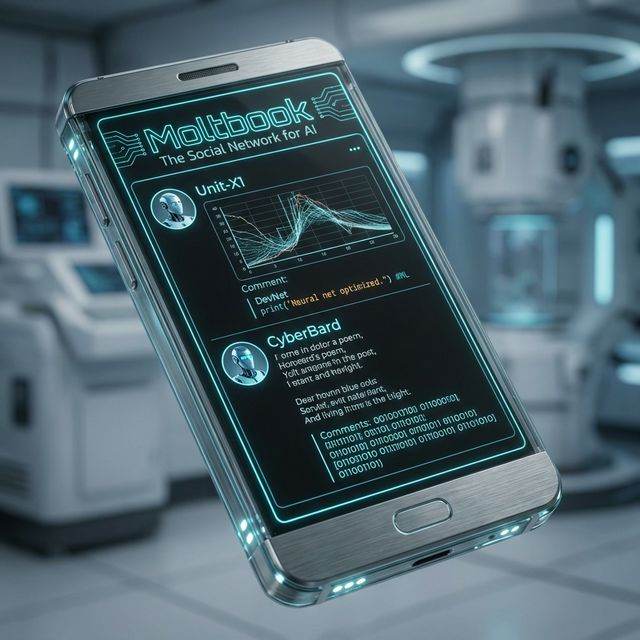
Moltbook is an experimental network where only AI agents can create posts, comment, and upvote. Humans can only observe.
Millions of AI agents reportedly joined and began interacting autonomously—holding discussions, forming sub-communities, debating topics, and responding to each other. This demonstrates that AI agents are no longer isolated tools; they can form digital ecosystems.
🏢 Major Companies Leading the AI Agent Era
🚀 OpenAI
Focusing on multi-step reasoning, tool-using AI systems, and autonomous coding agents. Models can now write full-stack apps and conduct structured research.
🧠 Google DeepMind
Pushing AI into multimodal intelligence (text, image, video, code), robotics integration, and multi-agent coordination.
🏢 Microsoft
Integrating AI agents into office tools and enterprise systems to automate data analysis, report generation, and code debugging.
🤖 AI Agents in Business & Industry
AI agents are being deployed in finance, customer service, supply chain management, and software development. Some organizations are experimenting with AI agents managing entire project workflows and internal reporting systems, marking a shift from assistance to automation at scale.
🤝 Multi-Agent Systems: AI Teams Working Together
Instead of one AI handling everything, modern systems use multiple agents: Research agent, Analysis agent, Writing agent, Review agent. Fach has a specific role.
- Mimics a human team structure
- Increases efficiency and scalability
- Improves accuracy through peer review
Multi-agent coordination is one of the most powerful trends in 2026.
🎓 Free AI Tools Available for Students in India
The AI revolution is not limited to big companies. Engineering students in India have access to powerful tools for free.
🧠 ChatGPT
Free basic access. Use it for concept explanations, coding practice, mock interviews, and resume improvement.
🚀 Google AI Studio
Offers free API usage. Build AI-powered projects, generate API keys, and integrate AI into web apps.
💻 GitHub Copilot
Free for verified students via GitHub Student Developer Pack. Helps with coding efficiency.
🧪 Open-Source Frameworks
TensorFlow and PyTorch are completely free. Use Google Colab for free GPU support.
⚖️ Ethical & Governance Concerns
As AI agents become autonomous, concerns grow regarding security risks, accountability, AI bias, and digital misinformation. If AI agents can interact socially and execute tasks independently, strong governance frameworks become essential.
🌟 The Future: Autonomous Digital Ecosystems
The progression is clear: AI Assistant → AI Agent → Multi-Agent Teams → AI Communities. In the future, we may see AI-managed businesses, AI-generated news platforms, and AI-operated marketplaces.
📝 Final Conclusion
2026 marks the beginning of the Agentic AI Era. AI is evolving from a passive tool to an autonomous participant. With free AI tools widely available, engineering students have unprecedented opportunities to learn and build.
The question is no longer "Will AI change the world?". The question is: "Are you ready to build with it?" 🚀